
Lyme Disease: The Basics
Lyme disease is one of several conditions that can be transmitted through tick bites. If you’re new to Lyme and other tick-borne diseases, understanding what they are and knowing where to find reliable information can feel overwhelming.
This guide covers the basics of Lyme disease and other tick-borne diseases, including symptoms, diagnosis, treatment, persistent symptoms, prevention, and where to learn more.
Lyme and other tick-borne diseases are complex. Research and clinical understanding continue to evolve. This page is intended for educational purposes and is not a substitute for medical advice.
What is Lyme disease?
Lyme disease, also called Lyme borreliosis, is a multisystemic infection caused by Borrelia bacteria and most commonly transmitted to people through the bite of infected ticks. In the United States, most cases are caused by Borrelia burgdorferi. Other Borrelia species may also cause Lyme disease.
Lyme disease can affect different parts of the body, and signs and symptoms can vary from person to person and over the course of illness. Early diagnosis and treatment are critical; delays in diagnosis and treatment have been associated with a greater risk of persistent symptoms.
Lyme disease is a tick-borne epidemic worldwide. In the United States, an estimated 476,000 people are diagnosed and treated for Lyme disease each year.
Lyme isn't the only tick-borne disease
Ticks can carry and transmit bacteria, viruses, and parasites that cause a range of conditions.
In the United States, tick-borne diseases and conditions include Lyme disease, babesiosis, Alpha-gal syndrome, anaplasmosis, ehrlichiosis, Rocky Mountain spotted fever, Powassan virus disease, hard tick relapsing fever, tularemia, and others. Which tick-borne diseases occur varies by geographic region and tick species.
People may also be exposed to more than one tick-borne pathogen. You may hear the term “co-infection” or “Lyme+” used when discussing multiple tick-borne infections.
What are the signs and symptoms of Lyme disease?
Lyme disease can cause a wide range of signs and symptoms, and everyone can experience it differently.
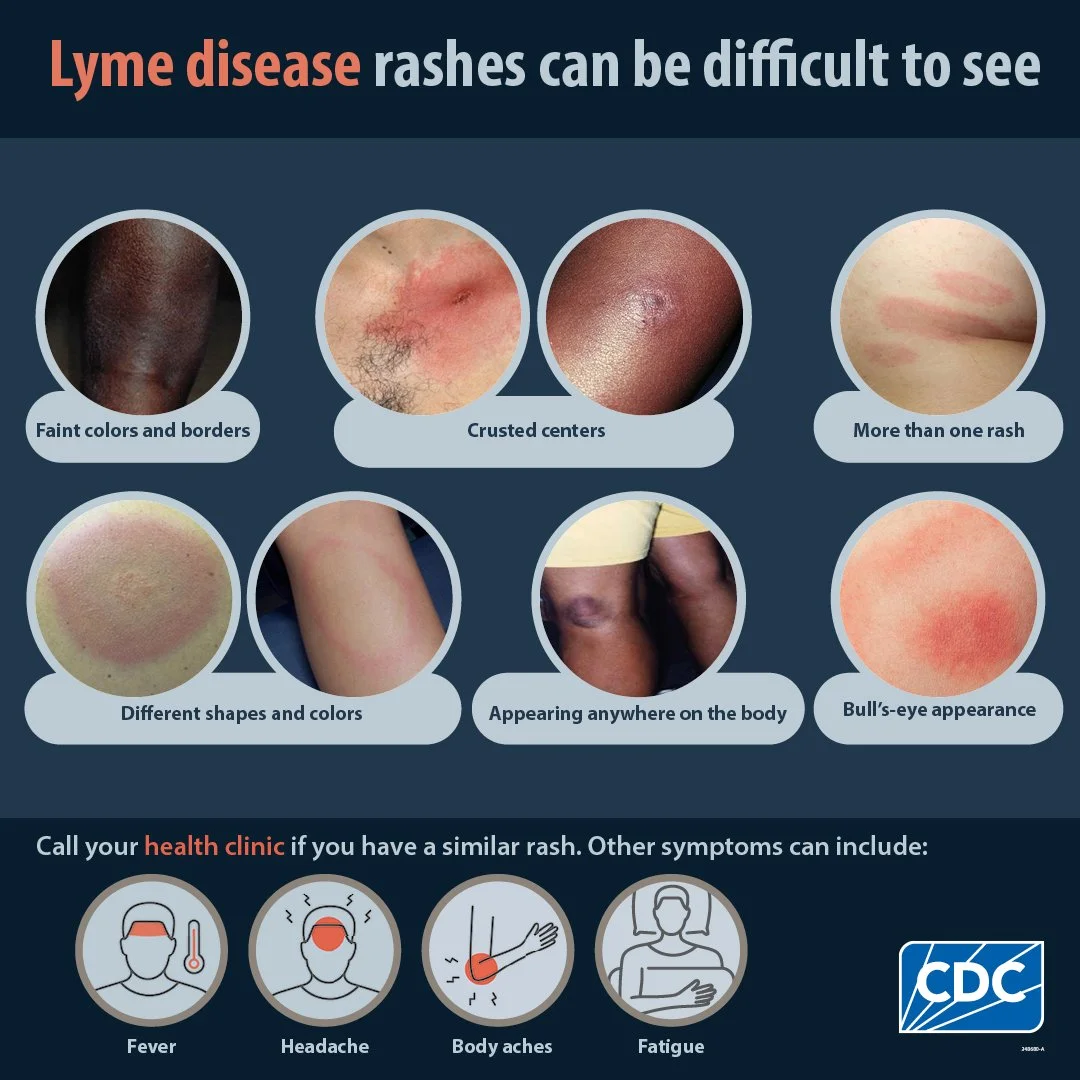
Early signs and symptoms can include fever, chills, headache, fatigue, muscle and joint aches, swollen lymph nodes, and an erythema migrans (EM) rash.
Not everyone with Lyme disease develops or notices a rash, and erythema migrans does not always have the commonly recognized “bullseye” appearance.
As Lyme disease progresses, it can affect different bodily systems, including joints, the nervous system, and the heart, and can become disabling or life-threatening.
Symptoms can be hard to pinpoint because they overlap with other illnesses.
If you are concerned about symptoms or possible tick exposure, talk with a qualified healthcare professional.
If you suspect Lyme or another tick-borne disease, you are welcome to join a Generation Lyme Meet-Up to connect with community members, though Meet-Ups do not replace medical advice or care.
How is Lyme disease diagnosed?
Getting a Lyme disease diagnosis can be complex. Testing has limitations and can produce negative results in some people with Lyme disease. This is particularly common early in infection, before detectable antibodies develop, and negative results can occur at other stages and under other circumstances.
If you're seeking a diagnosis, it may also be appropriate to discuss testing for other tick-borne diseases with your healthcare provider. Ticks can carry and transmit more than one pathogen, and symptoms of different tick-borne infections can overlap.
The International Lyme and Associated Diseases Society (ILADS) emphasizes that diagnosis should incorporate the full clinical picture and that no single element of the diagnostic process should outweigh the overall evaluation.
Laboratories such as IGeneX, TLabs, and Galaxy Diagnostics offer specialized testing options that may not be available through commonly used labs.
If you’re looking for a healthcare professional experienced in Lyme disease and other tick-borne diseases, Generation Lyme has compiled resources to help you begin your search.
How is Lyme disease treated?
The appropriate treatment for Lyme disease depends on a person’s individual circumstances and should be determined in consultation with a qualified healthcare professional.
ILADS has published clinical guidelines for treating Lyme disease. Healthcare professionals tend to have different levels of experience with Lyme and other tick-borne diseases, as well as varying familiarity with current research and clinical guidance.
Generation Lyme does not provide medical advice or recommend specific treatment protocols. We encourage people to discuss treatment decisions with qualified healthcare professionals.
What if symptoms persist?
People can continue to experience persistent symptoms after initial treatment for Lyme disease. These symptoms can be disabling.
There is documented evidence of persistent or chronic symptoms of Lyme, and researchers continue to investigate the exact cause behind this.
The 2025 National Academies consensus report, Charting a Path Toward New Treatments for Lyme Infection-Associated Chronic Illnesses, uses the term Lyme infection-associated chronic illnesses (Lyme IACI) to encompass persistent chronic illness associated with Lyme disease, recognizes it as a significant health challenge, and calls for further research and better approaches to diagnosis and treatment.
How can I prevent tick bites?
Preventing tick bites can reduce the risk of Lyme disease and other tick-borne diseases.
Ticks are widely distributed around the world and can be found in cities, suburbs, rural areas, and coastal environments—not just the woods. Tick species and the diseases they can transmit can vary by region. Use appropriate tick repellents, wear protective clothing when practical, and check yourself, children, pets, clothing, and gear for ticks after spending time outdoors. Take a hot shower within two hours of coming inside, and dry your clothes on high heat for at least 10 minutes to remove and kill ticks that may be on them.

If you find an attached tick, remove it promptly and save it in a sealed bag or container. Note when and where the bite occurred. Consider having the tick identified and tested for tick-borne pathogens, as this can provide information about potential exposure.
Monitor for symptoms and discuss questions about possible exposure, testing, or preventive treatment with a healthcare professional.
Where can I learn more?
Lyme and other tick-borne diseases are complex, and knowledge continues to evolve. No single webpage can answer every question about Lyme disease and other tick-borne diseases. Generation Lyme encourages people to explore credible information from organizations working across medicine, public health, scientific research, education, and patient advocacy.
Trusted Lyme & Tick-Borne Disease Resources
-
International Lyme and Associated Diseases Society (ILADS)
A multidisciplinary medical society providing clinician education, clinical guidelines, research, and resources related to Lyme and associated diseases. -
Bay Area Lyme Foundation
Research and education focused on Lyme disease diagnostics, treatments, prevention, and scientific discovery.National Academies — Lyme Infection-Associated Chronic Illnesses
The 2025 consensus study examining the evidence, research gaps, and need for better treatments for Lyme infection-associated chronic illnesses. -
Project Lyme
Educational resources for people navigating Lyme disease, including information about diagnosis, treatment, persistent illness, and finding care.LymeDisease.org
Extensive patient-focused information about Lyme disease, diagnosis, treatment, persistent illness, co-infections, and related topics.
LymeTV
Public health education and practical resources on tick-bite prevention, what to do after a bite, Lyme disease, and other tick-borne diseases.Center for Lyme Action
Information and opportunities to get involved in federal advocacy for Lyme and other tick-borne diseases, including efforts to advance research and funding across testing, treatments, and more. -
Tick-Borne Conditions United
Education and resources covering Lyme disease and a broader range of tick-borne conditions, with an emphasis on Alpha-Gal Syndrome.

Information is only one part of navigating tick-borne disease
Learning about Lyme can answer important questions while raising many more.
Generation Lyme is a patient-led 501(c)(3) organization offering free virtual Meet-Ups where patients, supporters, and people awaiting diagnosis can connect with others who understand what they're going through. If you’re navigating Lyme or another tick-borne disease, you’re not in this alone.
Sources & Further Reading
Generation Lyme draws on medical, scientific, public health, research, and patient-focused sources to develop and maintain this guide. Explore sources and additional reading by topic below.
-
Johns Hopkins Medicine Lyme Disease Research Center — Lyme Disease
Overview of Lyme disease, including how it spreads, how it can affect different parts of the body, and how the disease can progress.Kugeler et al. — Estimating the Frequency of Lyme Disease Diagnoses, United States, 2010–2018
Study estimating that approximately 476,000 people are diagnosed and treated for Lyme disease each year in the United States.Hirsch et al. — Risk Factors and Outcomes of Treatment Delays in Lyme Disease: A Population-Based Retrospective Cohort Study
Study showing that delays in Lyme disease treatment were associated with a greater risk of persistent symptoms.
-
Tick-Borne Conditions United — Other Tick-Borne Diseases
Information about Lyme disease and other tick-borne diseases and conditions.National Academies of Sciences, Engineering, and Medicine — Charting a Path Toward New Treatments for Lyme Infection-Associated Chronic Illnesses
Consensus report that discusses co-infections with multiple tick-borne pathogens and the challenges they can create for diagnosis and treatment.
-
Aucott et al. — Bull's-Eye and Nontarget Skin Lesions of Lyme Disease: An Internet Survey of Identification of Erythema Migrans
Study showing how Lyme disease rashes can vary in appearance, including rashes that do not look like a bull’s-eye.Aucott et al. — Diagnostic Challenges of Early Lyme Disease: Lessons from a Community Case Series
Discussion of clinical presentation and challenges involved in recognizing and diagnosing early Lyme disease.Bay Area Lyme Foundation — Skin Rashes
Patient-friendly information about Lyme disease rashes, including how often they occur and the different ways they can look.Schotthoefer et al. — The Spectrum of Erythema Migrans in Early Lyme Disease: Can We Improve Its Recognition?
Study of early Lyme disease rashes that found only 6% had the commonly recognized bull’s-eye appearance.Bay Area Lyme Foundation — Lyme Disease Symptoms
Overview of early, disseminated, and later manifestations, including neurologic, cardiac, joint, cognitive, and fatigue symptoms.Yeung & Baranchuk — Diagnosis and Treatment of Lyme Carditis: JACC Review Topic of the Week
Review of Lyme carditis, including serious effects Lyme disease can have on the heart.Fallon et al. — The General Symptom Questionnaire-30 (GSQ-30): A Brief Measure of Multi-System Symptom Burden in Lyme Disease
Study examining the wide range of symptoms people with Lyme disease can experience across multiple body systems.
-
Horn et al. (2026) — Evaluation of Standard and Modified Two-Tiered Testing Algorithms Using Well-Characterized Early Lyme Disease Samples
Study using Lyme Disease Biobank samples found that commonly used Lyme disease testing approaches had only 22% to 36% sensitivity at the initial blood draw.ILADS — 2024 Evidence-Based Guidelines Statement
ILADS statement addressing evidence-based approaches to Lyme disease diagnosis and treatment.Project Lyme — How Do You Test For It?
Information about Lyme disease testing, including limitations of commonly used approaches, interpretation of results, and specialized options.
Specialized Testing Resources
IGeneX — Specialized laboratory testing for Lyme and other tick-borne diseases.
TLab— Specialized laboratory testing for Lyme and other tick-borne diseases.
Galaxy Diagnostics — Specialized laboratory testing for Borrelia, Bartonella, and Babesia.
-
National Academies of Sciences, Engineering, and Medicine — Charting a Path Toward New Treatments for Lyme Infection-Associated Chronic Illnesses
Consensus report on persistent illness associated with Lyme disease and priorities for research, diagnosis, and treatment.Rebman & Aucott — Post-treatment Lyme Disease as a Model for Persistent Symptoms in Lyme Disease
Review of persistent Lyme disease symptoms, including their impact, possible causes, and areas of ongoing research.Project Lyme — Lyme Persists
Patient-focused resource exploring research into persistent Lyme disease, including why symptoms may continue after treatment and evidence of bacterial persistence.Fallon et al. — Regional Cerebral Blood Flow and Metabolic Rate in Persistent Lyme Encephalopathy
Columbia University-led study that found measurable differences in brain function in people with persistent cognitive symptoms following Lyme disease diagnosis.
-
Prevention & Tick Bites
Johns Hopkins Lyme Disease Research Center — Lyme Disease Prevention Tips & What to Do After a Tick Bite
Tick-bite prevention, tick checks, removal, and steps to take following a bite.Bay Area Lyme Foundation — Tick Testing
Information about saving and testing ticks after a bite.Project Lyme — Found a Tick?
Guidance on tick removal, saving a tick, identification, and testing.
Ticks Across Environments & Regions
Makwarela et al. — Tick Control Strategies: Critical Insights into Chemical, Biological, Physical, and Integrated Approaches for Effective Hard Tick Management
Review of tick populations around the world and approaches used to prevent and control them.Hansford et al. — Ixodes Ticks and Borrelia in Urban Green Space Across Europe
Study documenting ticks that can transmit Lyme disease and Borrelia bacteria in urban green spaces across Europe.VanAcker et al. — Enhancement of Risk for Lyme Disease by Landscape Connectivity, New York City
Research examining Lyme disease risk and infected ticks within an urban environment.Pittsburgh Regional Parks — Lyme Disease Risk from Infected Blacklegged Ticks
Research examining infected blacklegged ticks in urban/regional park environments.Research on tick distribution and tick-borne pathogens in urban recreational parks
Evidence concerning ticks and tick-borne pathogens in urban environments in China.Prevalence of Borrelia burgdorferi in Ixodidae Ticks Around Asia: A Systematic Review and Meta-Analysis
Systematic review examining B. burgdorferi prevalence in Ixodidae ticks across Asia.